PROGRAM DESCRIPTION
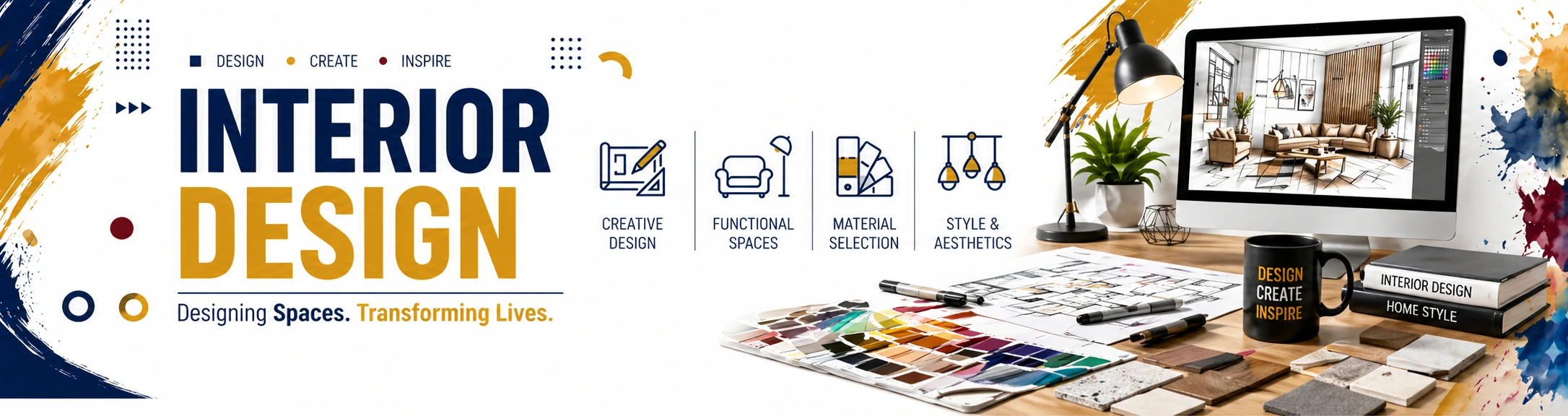
These diploma programs focus on preparing the student to work in a variety of interior design positions. This program will give students theoretical knowledge and the hands-on skills necessary to be successful. Students will acquire industry-standard software and technical skills and the knowledge to apply current industry policies, practices, procedures, and tools. Students will create a portfolio that showcases their professional design talents. Interior Design Diploma has an optional co-op component that can be taken after the completion of the academic year.
LEARNING OBJECTIVES
Upon completion of the program, students will have acquired industry-standard software and technical skills and the knowledge to apply current industry policies, practices, procedures and tools.
ADMISSION REQUIREMENTS
- Grade 12 graduate or mature student status (British Columbia 19 years or older)
- Meet minimum English language proficiency requirements.
CAREER OPTIONS
Upon successful completion, graduates will be able to secure entry-level interior design employment, for example as an interior decorator, residential and interior designer.
- Interior Decorator
- Residential Designer
- Interior Designer
Co-Op
The co-op will provide students with the opportunity to apply acquired theory and skills in a practical business setting. Students will gain real-world experience working on projects as a member of a team with project deliverables and deadlines.
IND300 Digital Drafting II
This course will build upon the tools and techniques learned in Digital Drafting I, introducing students to advanced features, commands, and functions, providing them with the tools to produce more complex designs, create simple 3D solids, and then adding an additional level of complexity to solids and surfaces.
IND320 Lighting
We are well aware of the influence of lighting on our everyday activities. Students will learn how to apply the principles, techniques, and changing technologies that are influencing how interior designers use light to achieve a desire effect or outcome.
IMD400 Office Design Studio
In this course students will solve an office design problem. Students will choose from one of four office design problems, each presenting a different design constraint (floor space, access, financial, location). They will propose and defend three possible solutions. The ‘client’ will make the final choice and each student will take the project to completion by applying office design best practices.
IND410 3D Rendering
Students will learn rendering techniques using industry standard software to create animated 3D walk throughs of their interior design solutions.
IND420 Interior Detailing
Building on what students learned in Building Materials students’ will focus on incorporating finishes on floors, walls, and ceilings. The expressive roll of architectural woodwork, window and door trim will be considered. This course will require students to document a variety of functional areas as well as produce material sample boards and sketch reference plans.
IND500 ID Studio
This is a portfolio preparatory course. Students will select what they consider to be their best assignments, and will organize these into a portfolio brief. They will develop a rationale for their selections and will be required to defend their choices. They will develop a final production plan that will demonstrate how they will raise the quality of their portfolio pieces to at a minimum, a professional industry standard. Upon approval students will proceed finessing their portfolio.
IND100 Art & Design Foundation
This course introduces students to the fundamentals and application of color theory and design. The course includes a short history of design, the physics of color and the fundamentals of the principles of design. Through a wide variety of art and design exercises students will learn to apply theory to artistic practice, learning how to apply basic design principles and color, creatively in finding solutions to design problems.
GRD100 Drawing
This course will teach students how to see the world, allowing you to sketch and accurately draw what is around you. Students will learn the fundamental concepts of drawing, how to use basic shapes, forms, lines and patterns, perspective (2/3D), scaling, proportions and lighting in the creation of realistic drawings.
GRD110 Digital Imaging I
This course introduces students to the industry standard digital imaging software – Photoshop. Students will learn the fundamentals of digital image manipulation and production, editing tools and techniques used in print and web production and will apply color and design principles in the creation of original compositions. Topics will include; color correction, layers, selection tools, brushes, masks, blending, filters, and file formats and output.
GRD120 Digital Illustration I
This course introduces students to the industry standard vector-based software used in manipulating photographic and bitmapped imagery and in the production of original illustrations used in magazines, advertising publications, technical documentation, game and video industries. Students will apply the basics of color and design in the creative production of a selection of industry specific illustrations. Topics will include; tools and functions, color palette applications, drawing and painting objects, using and creating masks and transparencies, type, effects, file formats and output.
GRD200 Drafting
This course introduces students to the fundamentals of traditional conventional drafting, using paper and pencil to produce detailed technical drawings.
IND200 Introduction to Interior Design
In this course students will explore how interior design in the western hemisphere has evolved in the last 150 years and how history continues to influence design in the 21st century. This information will be used to address a design problem by analyzing, planning for, and creating an interior space. Students will learn how to produce scale drawings, mood and sample boards in the creation and defence of their design solution.
IND110 Digital Drafting I
This course will introduce students to the fundamental tools and techniques of digital drafting using the industry standard software – Autocad. Students will become familiar with document windows, set up, tool commands, layers, text, and print and plot diagrams.
IND210 Building Materials
This course will introduce students to the wide variety of materials than can be used in designing interior spaces. Students will learn how materials are designed, manufactured and tested. Students will explore the uses of concrete, stone, glass, wood, metals, and fabrics. Students will be required to incorporate into their design solutions, materials on floors, walls, and ceilings. They will examine the roll of architectural woodwork, window and door trim in the design solution process. In response to design problems students will be required to produce material sample boards and sketch reference plans. There will also be a focus on the use of environmental friendly building techniques and products.
IND220 Space Planning
Effective space planning is fundamental to the successful execution of an interior design plan. Students will become familiar with the application of visualization techniques, diagraming, block plans, and matrices as they search for effective solutions to a variety of space problems.
IND230 Human Factors
Our living and working spaces are designed to facilitate the activities we perform there. In this course students will examine the role of anthropometrics, ergonomics, and budgeting on interior planning. Students will be required to apply this information in the design and evaluation of interior design.
IND310 Building Code
In this course students will become familiar with residential and commercial building codes and how they influence and guide the design of interior spaces. Students will learn how to create design solutions that are building code compliant.
IND315 Residential Design Studio
In this course students will solve a residential design problem. Students will choose from one of three residential design problems and propose and defend three possible solutions. The ‘client’ will make the final choice and each student will take the project to completion by applying residential design best practices.
IND330 Eco Design
In this course students will explore how to apply existing and emerging environmentally friendly design practices in interior design. Students will study the 'Leadership in Energy and Environmental Design' (LEED) rating system and through a series of focused design exercises will be able to demonstrate how to integrate LEED sustainability best practices in the solution of interior design problems.
IND430 Commercial Design Studio
In this course students will explore design problems associated with public, retail, industrial, and institutional spaces. Students will be presented with a design problem and will apply design and system processes to its solution. Working competitively in groups each will propose and defend a design brief. Brief evaluation will use an intragroup and inter-group assessment model. Based on 'client' feedback students will take the project to completion.
IND510 Building Information Modeling
This course introduces students to REVIT software. Revit is a Building Information Modeler (BIM) software tool used by architects, structural engineers mechanical, electrical and plumbing engineers, contractors and interior designers. The tool facilitates building design and modeling and allows the various project disciplines to embed additional building construction and design information into REVIT documents for reference.
IMD610 Portfolio
Building on the choices made with respect to their final portfolio design brief created in ID Studio, students will focus on perfecting their portfolio pieces so that they clearly reflect a personalized area of interest and expertise, and demonstrate competency mastery. Students will present their final portfolio to a panel of their peers and industry representatives.
CAP100 Career Preparation
This course prepares students for their job search by introducing them to interviewing skills, resume writing, cover letters, interview preparation, public speaking and an introduction to general customer service.
CAP200 Career Preparation Workshop
This course is to get students familiar with the work culture, communication employer – employee relationship and all necessary soft skills that are needed to secure a job. This course is spread over all terms and teaches students different levels of skills needed to obtain and keep a job.
Admission Requirements
- Grade 12 Graduate or a mature student
- Meet the Language proficiency requirements as listed below:
Prior to acceptance applicants must meet at least one of the following language proficiency requirements:
- Provide verified results for one of the English language proficiency tests listed below.
- International English Language Testing System (IELTS) Academic: overall score of 5.5 or higher.
- Test of English as a Foreign Language (TOEFL) IBT: overall score of 46 or higher
- Canadian Academic English Language (CAEL) Test: overall score of 40 or higher
- Canadian English Language Proficiency Index Program (CELPIP): Listening 6, Speaking 6, Reading 5, and Writing 5
- Duolingo English Test: overall score of 95 or higher
- Pearson Test of English (PTE) Academic: overall score of 43 or higher
- Cambridge English Qualifications: B2 First exam (FCE): overall score of 160 /"C" or higher
- Cambridge Linguaskill: overall: B2 level or higher
- LANGUAGECERT Academic: B2 level or higher
- The Michigan English Test (MET): B2 level or higher
- iTEP Academic: overall score of 3.5 or higher
- EIKEN: placement of Grade Pre-1 or higher
Test results must be dated no more than two years before the start date of the program.
Mature student applicants:
- Completion of 3 years of full-time secondary education (Grades 8-12) or 2 years of secondary education (including English 10 and 11 with a grade of 'C' or higher) from a country where English is one of the principal languages(This may be demonstrated by providing a high school transcript, completion of a BC Adult Graduation program or providing international education credentials recognized through WES, ICES, or IQAS.), or
- Completion of 2 years of full-time post-secondary education at an accredited institution where English is the language of instruction (Language development courses (i.e., ELL courses) cannot be included in this calculation), or
- Evidence that a language standard defined and accepted by a third-party regulator has been met. This may include minimum language standards or testing options set by a third-party regulator (e.g., Health Colleges, Public Registries, Transport Canada, etc.).
- Applicant is 19 years or older at the start of the program and is a Canadian citizen or permanent resident who cannot access is their educational records or provide sufficient evidence of secondary or post-secondary education as outlined above:
- Reading: 235
- Writing: 235
- WritePlacer: 4
Language development courses (i.e., ELL courses) cannot be included in this calculation. Accuplacer may not be used to demonstrate that a student meets an admission requirement other than language proficiency. For example, Accuplacer may not be used to demonstrate that a student meets a Math 11 admission requirement.
Graduation Requirements
- Successful completion of all program courses
- Successful completion of program Co-op (If applicable)
Program Duration
| Program | Hours |
|---|---|
| Total instructional hours | 960 |
| Total Co-op hours | 840 (if applicable) |
| Total program hours | 960 (No Co-op) - 1880 (With Co-op) |
| Total program length (weeks) | 48 (No Co-op) - 90 (With Co-op) |
Delivery Method
This program can be delivered in different methods,
-
On Site
The program will be delivered 100% in person*
Courses may be offered in a different order as long as prerequisites are met. Prerequisites are indicated in each course outline.
-
Distance
The program will be delivered 100% in an asynchronous** style except for the integrated work experience i.e practicum or co-op
Content of courses may be available at the same time OR in a different order as long as prerequisites are met. Prerequisites are indicated in each course outline.
-
Combined (Hybrid)
In this method, 50% of EACH COURSE of the program is delivered in person and the other 35% to 50% percent is delivered in synchronous** style and 0 to 15% in asynchronous*** style.
NOTE:
In this method, EVERY course of the program is delivered both in class and online. Courses may be offered in a different order as long as prerequisites are met.
Prerequisites are indicated in each course outline.
Students may ask SEA in writing if they want to take different percentages in class or online. Upon SEA’s approval, an amendment to the enrollment agreement must be signed.
*In person – means all classes of all courses are conducted on campus and students and instructors are on the same schedule and in the same physical location.
**Synchronous is when students and instructors are on the same schedule but can log in to a virtual class at the same time, only from different physical locations.
***Asynchronous is when students are on their own schedule and log in to the school management system at their own time, submit assignments on their own schedule and within a specific timeframe and are in touch with instructors via email and not necessarily at the same time and/or time zone.
Learning Objective
Upon completion of the program, students will have acquired industry-standard software and technical skills and the knowledge to apply current industry policies, practices, procedures, and tools.
Career Options
Upon successful completion, graduates will be able to secure entry-level graphic design employment, for example as a digital illustrator, layout specialist, graphic artist and design software specialist.
- Digital Illustrator
- Layout Specialist
- Graphic Artist
- Design Software Specialist
Co-OP
The co-op will provide students with the opportunity to apply acquired theory and skills in a practical business setting. Students will gain real-world experience working on projects as a member of a team with project deliverables and deadlines.
Downloads
Download Course With Co-Op Prospectus
Download Course Without Co-Op Prospectus